Peptide Calculator
A modern, fast and reliable peptide calculator designed for researchers and advanced users to calculate peptide Dosage accurately. Near about 1-3 million people in USA use peptide injections for fitness and antiaging purpose. This advanced peptide dosing calculator helps you determine the exact mg to mL conversion, ensuring accurate reconstitution and dosing every time.
For research purposes only · Not medical advice · peptidecalcu.com
to see fill
Reviewed for Accuracy: All reconstitution formulas and dosing reference data on this page have been verified against peer-reviewed pharmacokinetic literature and CDC subcutaneous injection guidelines. Last reviewed: July 2026. For research and educational purposes only.
How the Peptide Dosage Calculator Works
This calculator helps you quickly determine peptide concentration and the exact injection volume (mL) after mixing your peptide with water.
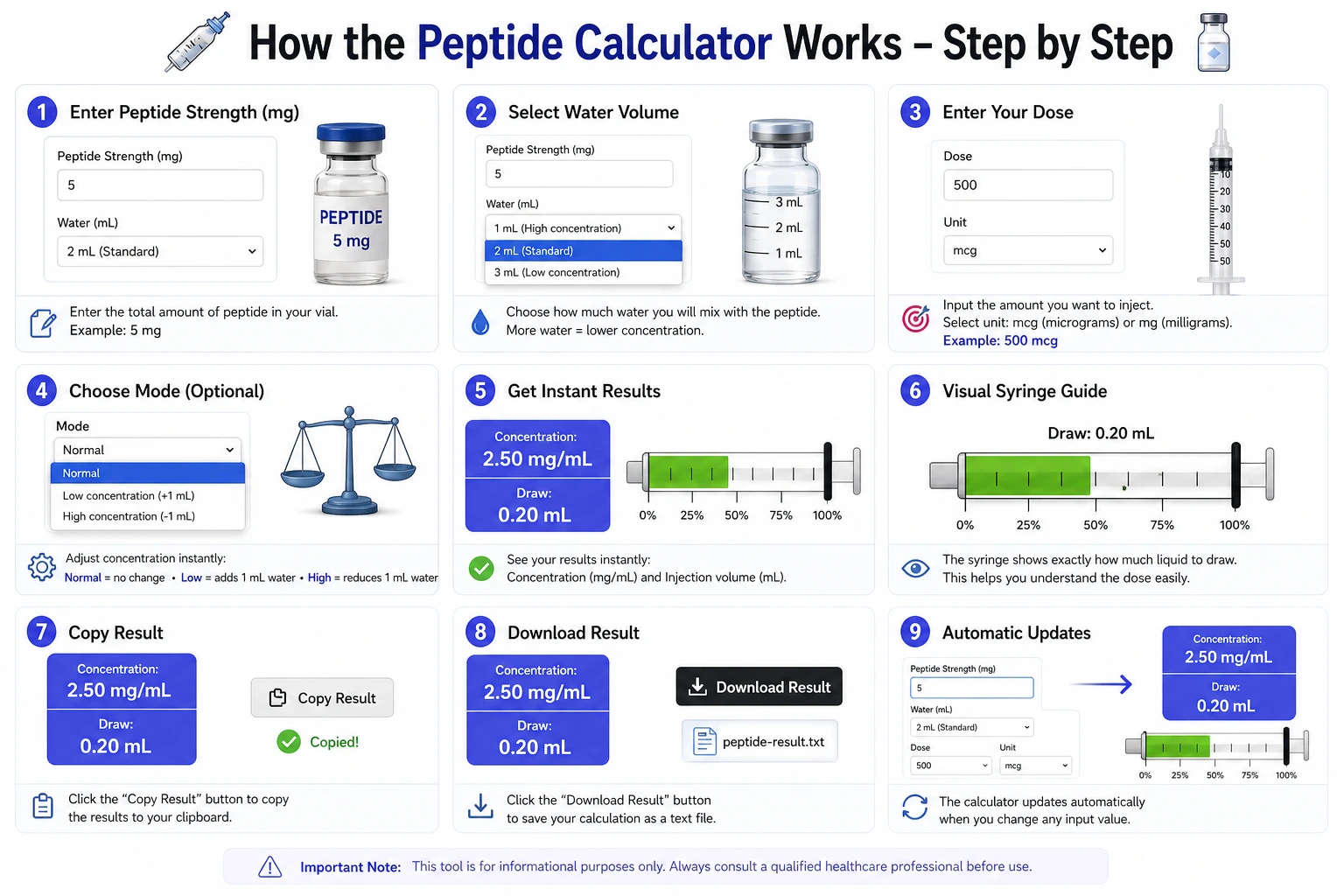
Step 1: Enter Peptide Strength (mg)
- This shows the total amount of peptide in your peptide vial.
- Example: 5 mg
Step 2: Select Water Volume in mL
Choose how much bacteriostatic water you are adding:
- 1 mL will makes high concentration solution
- 2 mL will make Standard solution (recommended)
- 3 mL will make Low concentration solution
Step 3: Enter Your Dose
- Input the amount you want to inject
- Example: 500 mcg
Step 4: Choose Mode
This feature adjusts water automatically:
- Normal → no change
- Low concentration → adds +1 mL water
- High concentration → reduces 1 mL water
Output Verified: The calculator displays concentration (mg/mL), draw volume (mL), and syringe units simultaneously. Always cross-check the draw volume against the manual formula before administering any dose.
Why Use This Peptide Dosing Calculator?
Instant Dosage Calculation
Instant Download Results
Results With Visual Syringe Guidance
Optimized For Peptide Reconstitution
Syringe Type Comparison — Which Size Should You Use?
Choosing the correct syringe size for your dose is as important as the calculation itself. Graduated marks are spread further apart on smaller syringes, making measurement more precise for low-volume doses.
| Syringe Size | Total Volume | Scale Markings | Best For | Precision |
| 0.3 mL / 30U | 30 units max | 1 unit intervals | Very small doses: 50–200mcg | Highest |
| 0.5 mL / 50U | 50 units max | 1 unit intervals | Low-mid doses: 100–500mcg | High |
| 1.0 mL / 100U | 100 units max | 1–2 unit intervals | Mid-high doses: 500mcg–2mg | Standard |
For doses under 10 units (0.10 mL), always use a 0.3mL or 0.5mL syringe. On a 1mL syringe, 10 units is a very short fill that is easy to misread. The finer graduations on smaller syringes dramatically reduce measurement error at low doses.
Bacteriostatic Water & Reconstitution Guide
Bacteriostatic water is sterile water preserved with 0.9% benzyl alcohol USP grade, which inhibits bacterial growth and allows multi dose use over the vial’s usable lifespan. It is specifically designed for reconstituting lyophilized freeze dried peptide powders before injection. Do not substitute with regular sterile water for injection which has no preservative and is single use only or saline which can precipitate some peptides.
Standard Reconstitution Ratios by Vial Size
| Vial Size | BAC Water: Low Conc. | BAC Water: Standard | BAC Water: High Conc. | Most Common |
| 2 mg | 2 mL → 1 mg/mL | 1 mL → 2 mg/mL | 0.5 mL → 4 mg/mL | 1 mL |
| 5 mg | 3 mL → 1.67 mg/mL | 2 mL → 2.5 mg/mL | 1 mL → 5 mg/mL | 2 mL |
| 10 mg | 3 mL → 3.33 mg/mL | 2 mL → 5 mg/mL | 1 mL → 10 mg/mL | 2 mL |
| 20 mg | 4 mL → 5 mg/mL | 2 mL → 10 mg/mL | 1 mL → 20 mg/mL | 2 mL |
| 30 mg | 6 mL → 5 mg/mL | 3 mL → 10 mg/mL | 2 mL → 15 mg/mL | 3 mL |
Peptide Reconstitution Technique — 7 Steps
Proper technique protects peptide potency. Incorrect reconstitution — particularly foaming from direct water-to-powder contact — can denature the peptide structure and reduce efficacy:
- Clean both vial tops (peptide vial and BAC water vial) with 70% isopropyl alcohol swabs. Allow 30 seconds to air dry.
- Draw your chosen BAC water volume into the drawing syringe using an 18–21 gauge needle.
- Insert the drawing needle into the peptide vial at an angle. Direct the BAC water stream at the INNER WALL of the vial — not directly onto the peptide powder cake.
- Inject the BAC water slowly down the wall over 15–20 seconds.
- Gently swirl the vial in small circles for 30–60 seconds. Do NOT shake vigorously — mechanical agitation can break peptide bonds.
- Allow 3–5 minutes if any powder remains. Final solution should be clear and colorless.
- Label with reconstitution date and concentration. Refrigerate immediately at 2–8°C (35–46°F). Do not freeze reconstituted peptide.
Storage: Lyophilized (unreconstituted) vials: store at −20°C for long-term. Reconstituted peptide solutions: refrigerate at 2–8°C and use within 28–30 days per standard peptide stability data for BAC water-preserved solutions. Discard immediately if solution appears cloudy, discolored, or has visible particles. (Source: CDC Vaccine Administration Guidelines, subcutaneous preparation standards.)
Peptide Reference Chart — Common Vials, Doses & Calculator Inputs
The following reference table provides standard protocol data for the most commonly researched peptides. Use these values as starting inputs in the peptide dosage calculator. All doses reflect published preclinical or clinical research protocols — not medical recommendations.
| Peptide | Common Vial | Typical Dose Range | Frequency | Route | Calculator Page |
| BPC-157 | 5 mg | 250–500 mcg/day | Daily | SubQ / Oral | BPC-157 Calculator ↗ |
| TB-500 | 5 mg | 2.5–5 mg 2x/week | 2x/week | SubQ | Peptide Calculator |
| Semaglutide | 3 mg | 0.25–2.4 mg/week | Weekly | SubQ | Semaglutide Calculator ↗ |
| Tirzepatide | 5 mg | 2.5–15 mg/week | Weekly | SubQ | Tirzepatide Calculator ↗ |
| Retatrutide | 10 mg | 2–12 mg/week | Weekly | SubQ | Retatrutide Calculator ↗ |
| Tesamorelin | 2 mg | 1–2 mg/day | Daily | SubQ | Tesamorelin Calculator ↗ |
| MOTS-C | 10 mg | 200–1,000 mcg/day | Daily | SubQ | Peptide Calculator |
| GHK-Cu | 50 mg | 1–2 mg/day | Daily | SubQ / Topical | Peptide Calculator |
| Ipamorelin | 5 mg | 200–300 mcg/day | Daily | SubQ | Peptide Calculator |
| CJC-1295 | 2 mg | 100–300 mcg 2x/wk | 2x/week | SubQ | Peptide Calculator |
| KPV | 10 mg | 200–500 mcg/day | Daily | SubQ / Oral | Peptide Calculator |
Reference only. All doses above are from published preclinical or clinical research — not prescriptions or medical recommendations. Consult a licensed physician for all protocol decisions
Worked Calculation Examples — Verify Your Results
Use these examples to cross-check your calculator outputs manually before each injection:
Example A — BPC-157: 5mg Vial, 2mL BAC Water, 250mcg Dose
Concentration: 5mg ÷ 2mL = 2.5 mg/mL (= 2,500 mcg/mL)
Draw volume: 250mcg ÷ 2,500mcg/mL = 0.10 mL
Syringe units (U-100): 0.10 × 100 = 10 units
Vial doses at this dose: 5,000mcg ÷ 250mcg = 20 doses
Example B — Semaglutide: 3mg Vial, 1.5mL BAC Water, 0.25mg Dose
Concentration: 3mg ÷ 1.5mL = 2 mg/mL
Draw volume: 0.25mg ÷ 2mg/mL = 0.125 mL
Syringe units (U-100): 0.125 × 100 = 12.5 units (draw to 12–13 unit mark)
Vial doses at this dose: 3mg ÷ 0.25mg = 12 weekly doses
Example C — Tirzepatide: 5mg Vial, 1mL BAC Water, 2.5mg Dose
Concentration: 5mg ÷ 1mL = 5 mg/mL
Draw volume: 2.5mg ÷ 5mg/mL = 0.50 mL
Syringe units (U-100): 0.50 × 100 = 50 units
Vial doses at this dose: 5mg ÷ 2.5mg = 2 weekly doses
Subcutaneous Injection Guide — Safe Administration Technique For Peptides
All peptide research protocols in this reference guide use subcutaneous (SubQ) injection — administering the solution into the tissue layer between the skin and muscle. Per CDC vaccine administration guidelines and MedlinePlus subcutaneous injection instructions, the following technique applies:
Approved Injection Sites For Peptides
- Abdomen: most commonly used — at least 2 inches (5cm) from the navel in any direction
- Outer thigh: mid-thigh lateral surface — good rotation alternative
- Back of upper arm: outer surface only — requires assistance or mirror for self-injection
Site Rotation: Rotate injection sites systematically with every dose. Repeated injection at the same site causes lipohypertrophy — fatty nodules that form under the skin and impair peptide absorption. Per MedlinePlus guidelines, map a consistent rotation pattern (e.g., left abdomen → right abdomen → left thigh → right thigh) and follow it without deviation.
Peptide Calculator — Global Availability & Regulatory Context (2026)
PeptideCalcu.com’s free peptide dosage calculator is used by researchers, medical professionals, and compounding pharmacy staff across the United States, United Kingdom, Canada, Australia, Germany, and more than 30 additional countries where research peptide use is permitted.
Regulatory context (USA, July 2026): Research peptides are available through licensed compounding pharmacies with physician prescription in all 50 US states. The FDA regulates compounded peptides under 503A and 503B frameworks. Researchers should always verify the current regulatory status of specific peptides in their jurisdiction before sourcing or administering any compound. This calculator does not facilitate purchase or administration — it is a mathematical conversion tool for research planning purposes only.
Note on Specific Peptides: Regulatory status changes rapidly in this space. Retatrutide (LY3437943) remains investigational (no FDA approval as of July 2026). Tirzepatide (Zepbound/Mounjaro) and Semaglutide (Ozempic/Wegovy) are FDA-approved drugs — compounded versions are subject to specific FDA shortage and outsourcing regulations. Always consult current FDA guidance for the specific compound you are researching.
What Are Peptides?
Proteins contain 50+ amino acids and have complex three dimensional structures but peptides are very small and cross cell membranes easily to interact directly with receptors, enzymes and DNA transcription factors.
Research peptides broadly studied as of 2026 include GLP-1 receptor agonists (semaglutide, tirzepatide, retatrutide), tissue repair peptides (BPC-157, TB-500), mitochondrial-derived peptides (MOTS-C, humanin), collagen-stimulating peptides (GHK-Cu), growth hormone secretagogues (ipamorelin, CJC-1295, tesamorelin), and anti-inflammatory peptides (KPV, larazotide). Each category has distinct mechanisms, dose ranges, and vial sizes — which is precisely why a flexible peptide dosage calculator that works across all compounds is essential.
Benefits Of Peptides?
Peptides can support specific functions in the body without any harmful effect to the whole body.
Muscle Growth & Recovery
Collagen Peptides, Klow Peptide and many other help in muscle growth and body building. They also speed up recovery after gym workouts by increasing protein synthesis and repair of damaged tissues.
Fat Loss Support
Some peptides like tirzepatide boost the metabolism of body and help the body to use fat more efficiently. That is why peptides help in weight loss.
Faster Healing
Peptides support the cell repair and may help in recovery from injuries by helping tissue regeneration.
Improved Sleep & Hormone Balance
Ipamorelin peptides are associated with better sleep quality and balanced hormone release in body especially growth hormone.
Better Focus And Energy
BPC-157 peptides improve the mental clarity, focus, and overall body energy levels.